How Dry Construction is Changing the Way India Builds
Homes, hospitals, factories, data centres, airports, schools, and offices are all growing throughout India’s cities and new corridors at a rapid pace. Construction is under pressure to deliver more quickly, maintain quality, and make efficient use of raw resources, water, and energy due to this increase.
Wet construction has been the norm for many years, utilizing bricks, blocks, cement mortar, plastering, and curing. Despite its effectiveness, it currently confronts difficulties due to strict deadlines, lack of workers, waste, and performance standards.
Dry construction is changing this strategy. It is now widely used for building envelopes, ceilings, wall linings, partitions, and dry flooring. The global market is expected to increase from approximately USD 245 billion in 2024 to USD 400 billion by 2034, indicating a more efficient future.

The Shift from Wet to Dry Construction is Accelerating
Dry construction replaces many on-site wet processes with systems such as boards, metal framing, insulation, compounds, and engineered accessories. Installation becomes predictable, and less dependent on site improvisation.
Wet construction remains for structures and foundations, but it can be affected by weather, moisture, curing, mixing, and workmanship. Dry construction reduces these variations through standardised materials and tested system designs.
Developers and contractors value cleaner sequencing. Electrical and plumbing services can be integrated more efficiently, while openings and modifications cause less disruption. Tighter finishing tolerances can improve project delivery and reduce rework.
The growing demand for acoustic comfort, fire performance, and thermal efficiency is accelerating adoption. Commercial, healthcare, hospitality, and education projects need these qualities. Dry systems can provide them as part of the specification rather than relying on site adjustments.
Faster Timelines and Improved Labour Efficiency
Time has become highly important in construction today. Delayed handovers affect revenue, financing costs, leasing, and customer confidence. Dry construction helps shorten schedules because installation involves fewer drying and curing periods.
Partitions and ceilings can be installed alongside other activities, reducing waiting time and improving coordination. Less dependence on water and wet trades allows projects to progress with greater certainty.
Labour efficiency improves through repeatable installation methods and structured training. Modern construction techniques can raise productivity through coordinated workflows and reduced reliance on traditional wet trades. Trained installers follow defined guidelines and use standard tools, while skill-development and certification initiatives can strengthen workmanship and safety.
Quality control becomes easier to manage as supervisors can check alignment, fixings, joints, and finishing against clear benchmarks. Better process control can reduce rework and support consistent results, helping India deliver projects faster while building a stronger skilled workforce.

Sustainability, Waste Reduction and Resource Optimisation
Sustainability is connected to regulation, investor expectations, and business responsibility. It makes economic sense. Dry construction can reduce on-site water use because many installation and finishing stages do not require mixing, curing, or prolonged wet work.
Waste reduction is another major advantage. Prefabricated systems can significantly reduce waste compared with conventional site-intensive methods. Wet construction often produces debris through cutting, breakage, plastering, and rejected batches. Dry systems support more accurate planning, precise installation, and waste management.
Resource optimization extends further. Lighter wall systems can reduce dead loads and influence structural decisions in buildings. Better thermal and acoustic performance can reduce operational impacts, particularly in air-conditioned spaces, while fire performance and indoor comfort contribute to safer, healthier buildings.
Dry construction encourages a shift from choosing individual materials to designing complete systems. When walls and ceilings are treated as engineered assemblies, performance can be measured, documented, and improved. This approach supports green building goals and responsible procurement.
Regulatory Influence on Modern Construction Practices
As rules, approvals, safety standards, and performance benchmarks change across asset classes, India’s building environment becomes more formalized. Developers that collaborate with global occupiers, institutional capital, and public infrastructure are now required to show that they adhere to established quality and regulatory frameworks. Dry construction uses approved, performance-rated, and tested system-based criteria to facilitate this change. Reducing site-level interpretation, certified assemblies, and recognized standards validate fire assistance, acoustic insulation, structural stability, and moisture control. This strategy is reinforced by procurement procedures, which makes approvals, audits, and long-term compliance easier with documented product certifications and installation requirements.
Scope and Limits
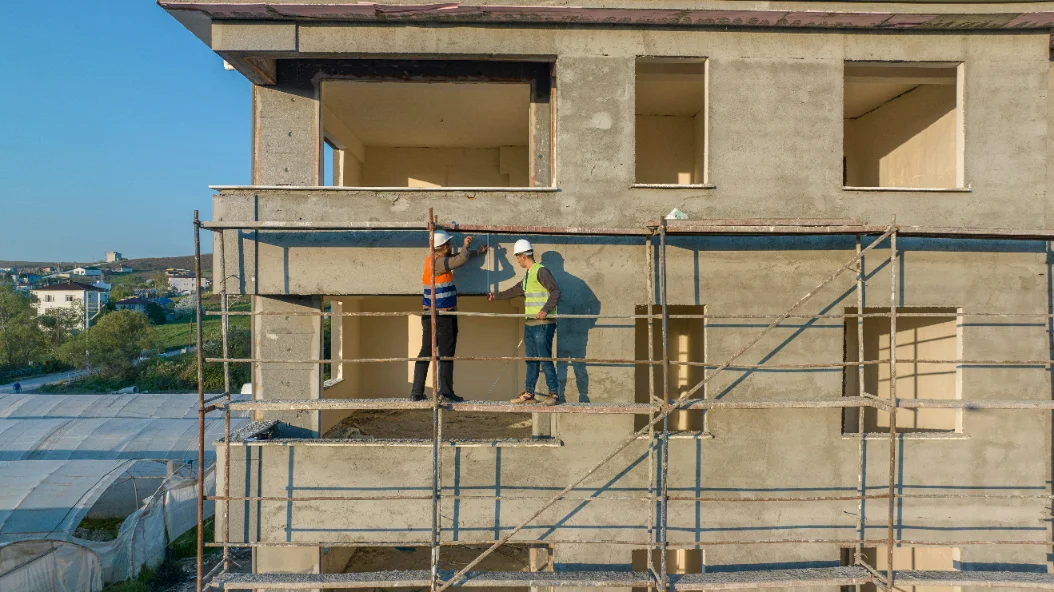
In today’s building environment, the effectiveness of a project is often based on how well dry and wet construction techniques are balanced. The industry is currently moving toward a distinct technical boundary: dry methods for everything else, including the building envelope and interiors, and wet methods for the foundations and structural bones.
Despite their rapidity, dry methods have specific physical limitations in terms of mass, compressive strength, and sub-surface durability.
What Does This Mean For India’s Construction Future?
Dry construction is changing how interior spaces are delivered and performance is attained, although it does not completely replace all building activities. While interiors evolve toward quicker, system-driven execution, structural and fundamental work will still rely on wet methods. This shift gives capability building similar weight throughout the value chain. Infrastructure delivery and human development are being strengthened by modern building technologies, which are backed by government-led skill development and workforce formalization. Consistency, responsibility, and expert execution at scale will be rewarded in the next stage of growth.

